
Costs and pricing
Part of Before you price a subscription product, work out what it really costs
Why a subscription commerce budget template keeps your numbers honest
Build a subscription commerce budget template that survives scrutiny: choose the right cost lines, date every assumption and reconcile actuals against plan monthly.
What to take away
- Start with the totals, not the template. The ONS digital economy statistics on UK e-commerce and ICT activity show the size of the online economy your subscription revenue sits inside. Your revenue line needs a defensible base rather than a guess.
- Split costs into three blocksplatform and payment fees, acquisition, and retention and service. Each behaves differently when volume changes.
- Put every assumption in a cell with a source and a date, so a reviewer can trace it.
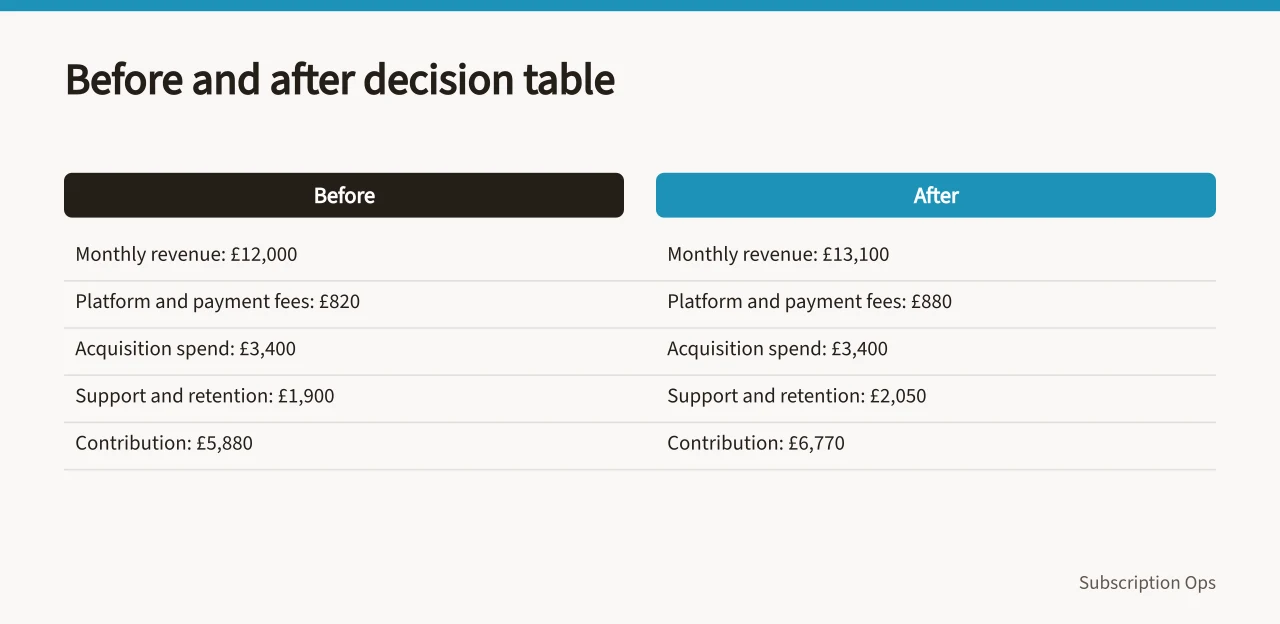
- Build a before/after view of any pricing or retention change, because a budget only earns its keep when it tests decisions.
- Reconcile monthly. A template that is not updated is a historical document.
Why a template beats a spreadsheet you build each quarter
A budget template is a set of linked assumptions you reuse. A one-off spreadsheet is a fresh set of guesses every time.
Use four tabs: Assumptions, Monthly actuals, Variance, Before and after. The Assumptions tab has one row per line with columns for assumption, source, date set, and notes. The Monthly actuals tab repeats those lines with plan, actual, and variance in pounds and per cent. The Variance tab flags any line more than ten per cent adrift.
Keep one master file. Date each release and note who changed what.
Start from the wider cost structure in the subscription commerce costs and budget guide for England, which sets out the categories most operators need before adding anything bespoke.
The cost lines to include
| Block | Typical lines | Behaviour as volume grows |
Add a fourth block for one-off work: migration, integration and legal review. Those land once, so flag them rather than spreading them across the year.
Cost lines and volume behaviour
Cost block
- Platform and payments
- Mostly variable
- Acquisition
- Fully variable
- Retention and service
- Steps up in bands
- One-off work
- Lands once
Behaviour as volume grows
- Platform and payments
- Some fixed minimums
- Acquisition
- Retention and service
- One-off work
- Flag, don't spread
Fixed minimums bite hardest in quiet months, so model a low-volume scenario alongside your plan.
For example, a team paying £400 a month for a platform plus one per cent on payments would model a 6,000-subscriber month differently from a 2,000-subscriber month. At 6,000 subscribers paying £10 a month, gross revenue is £60,000. Platform fee: £400 plus £600.
Payment processing at a typical 1.5 per cent plus 20p: £2,100. Support for two agents at £1,300 each: £2,600. Treat those figures as illustrative, not market rates.
Evidencing the numbers
Use the ONS digital economy statistics on e-commerce and ICT activity to frame the size of the online economy you sit inside, then narrow it with your own conversion data.
Where the model depends on subscriber data, payment records or contact details, the ICO's security guidance on the UK GDPR integrity and confidentiality principle requires appropriate technical and organisational measures. Compliance work is a cost line, not an afterthought.
Building the before and after table
A template earns trust when it shows the effect of a decision.
Current plan
- Subscribers
- 2,000
- Price per month
- £12
- Gross revenue
- £24,000
- Platform fee
- £640
- Payment processing
- £760
- Support
- £2,000
- Total costs
- £3,400
- Contribution
- £20,600
After change
- Subscribers
- 1,900
- Price per month
- £14
- Gross revenue
- £26,600
- Platform fee
- £666
- Payment processing
- £779
- Support
- £2,000
- Total costs
- £3,445
- Contribution
- £23,155
Those figures are illustrative. The contribution line shows the net effect of the change.
Pair the table with the subscription commerce return on investment analysis so the payback period sits next to the monthly numbers rather than in a separate deck.
Reviewing the template monthly
Set a fixed date each month to update actuals against plan. Variance over ten per cent on any line needs a written reason.
If a customer disputes a charge or cancels mid-term, the GOV.UK help for consumers guidance sets out what consumers are entitled to, which shapes your refund and dunning provisions.
Common questions
How many cost lines should a template hold?
Enough to explain the variance, no more. Most operators need between fifteen and twenty five lines before the model stops being readable.
Should the template include VAT?
Yes, but keep net and gross columns separate. Subscription pricing is usually quoted inclusive of VAT to consumers, so the budget needs the gross figure for cash planning and the net for margin.
How often should assumptions be re-evidenced?
At least every quarter, and immediately after any vendor price change. An assumption older than six months should be treated as unverified until someone confirms it.
What is the biggest mistake in subscription budgets?
Treating acquisition cost as a single blended figure. Splitting it by channel shows which spend is actually buying retained subscribers rather than trials that lapse.